Rwinkwavu
Background
The Rwinkwavu mine sector is located in the Kayonza District in the Eastern Province. It is reached by the Kigali-Kabarondo road (94 km), then take the kabarondo – akagera road (11 km), The area of this concession is 8,250 ha and Currently the Rwinkwavu mine operated by the company bugambira Ltd, extends over Six Sectors namely the sector of Rwinkwavu, Mwili, Nyamirama, Murama, Kabarondo and Gahini, all of the district of KAYONZA in the province of the EST. mining concession distributed in 7 zones of activities which are: Gahengeri, Gahushyi, Nyarunazi, Rutonde, Kibaya, Gihinga and Migera. All of zones are extracting only cassiterites. The discovery of the Rwinkwavu deposits by the GARGARATHOS brothers dates back to the 1930s. Mining began in 1939 by MOSS, RIDELL, De BORGHRAVE and GASTRELL and was streamlined in 1942 by the DMPG, then in 1945 by GEORWANDA (a branch of GEOMINES Co of Zaire). The oldest logging data currently available dates from 1945.
Examination of these archives reveals that logging, which began on Mounts Rwinkwavu and Musumba, It is possible to say that in 1945, the systematic and methodical exploration and exploitation of the Rwinkwavu deposit started.
In 1974, the concession was transferred to SOMIRWA (Société des Mines du Rwanda). SOMIRWA’s production (1977-1985) totaled 1290 tonnes of SnO2 concentrate and 4.4t of tungsten concentrate (probably ferberite concentrate).
SOMIRWA went bankrupt in 1985 and the Rwandan state took over responsibility for most of the country’s mining companies. For this reason, REDEMI (Régie d’Exploitation et de Développement de Mines) was founded in 1989. In 1989-1994, the exploitation of the Rwinkwavu deposits continued by methods industrial”.
In February 2008, the company was privatized and sold to the Rwandan company Bugambira and acquired the Rwinkwavu special license N°123/16.03/05 of 03/01/2008. The opening ceremony of the Bugambira Ltd operation in Rwinkwavu took place on February 11, 2008.
In December 2016, the Ministry of Natural Resources and Mining issued a permit to the Rwinkwavu mining concession for a period of 15 years.
Research
The discovery of the Rwinkwavu deposits by the GARGARATHOS brother’s dates back to the 1930s. In 1964, A. Slatkin (Israel Institute of Technology) presented the study, where she divided the Sn mineralized veins into three groups. The most interesting are,
from his point of view, the veins hosted in the shales, near the base of the shales.
In 1967, KRUPP ROHSTOFFE, G.m.b.H., at the request of the Rwandan government, carried out detailed geological and cartographic work in all sectors (400 km2). The principal objective of the work was to find an extension of the mineralization of Rwinkwavu towards the north (direction of Akagera National Park).
As our mines situated in the East of Rwanda, are well known for the occurrence of quartz veins mineralized with cassiterite and minor wolframite. Large volume of Rwinkwavu ore is concentrated in the hinge zone of the fold.
In 2015, the results of a study carried out by Bugambira ltd, aimed at Collection and use of all geological information available on the region Sampling and mapping of the ore bodies, logging of the bore holes, Production of the detailed geological report for the above said works. Stated that the topography of the area is characterized by a bass relief with weak slopes. The altitude varies from 1375 m to 1,600 m above sea level. The main crops grown in the area are beans, sorghum, bananas, rice, and sweet potatoes. Parts of the area are covered by eucalyptus trees.
Geological map of the area illustrates mainly low grade metamorphic rocks of the Rukira and Kibaya formations. The stratigraphy in the area are as follows:
- Rr: Rukira Formation: Pelitic rocks are predominant, mainly represented by black shales and more by shales and fine grained sandstone alternating with laminated or thin bands of siltstones.
- Kb: Kibaya formation (300 m) Alternation of mixtures of two decametric types: fine grained quartzite or sandstone in small layers, rarer are the coarse grained sandstone with some small clasts of black shale; alternation of lenticular layers of sandstone and schists.
- The deposits are hosted in sandstones and schists, micaceous, locally folded. These rocks were injected by quartz or pegmatite masses, usually stanniferous.
- Reserves estimation based the method profiles because Rwinkwavu deposits are recognized by pitting and drilling, reserve estimation of tin is 23,484T
Exploitation
Due to the important primary mineralization is distributed close to the axis of the anticline, and veins grouped in irregular bundles of up to several hundred meters wide and of very variable length, up to 700m. some veins are oriented obliquely.
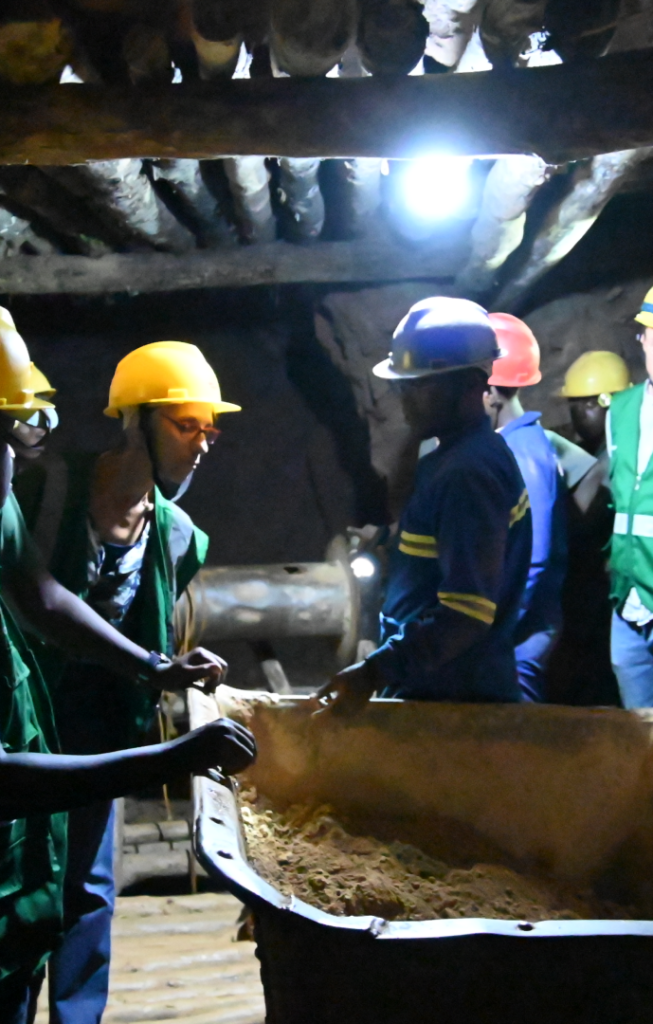
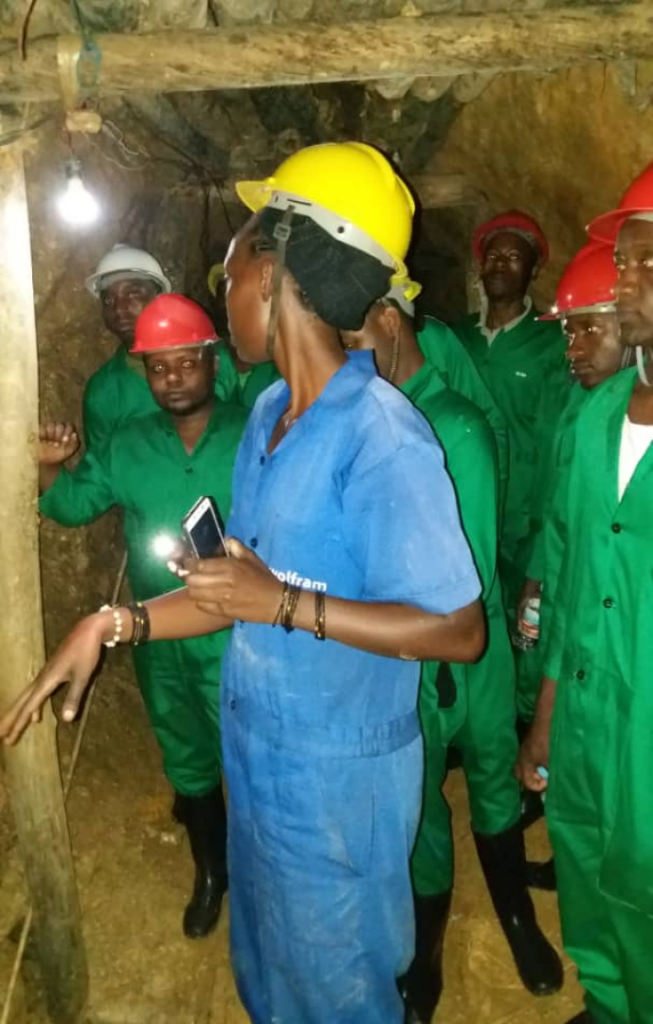
Nowadays we are accessing the veins through shafts (pits) and Drifts (Adits). When we discover a vein we begin sinking a shaft and above it sets up a windlass, and builds a shed over the shaft to prevent the rain from falling in, lest the men who turn the windlass be troubled by the rain. The windlass men also place their barrows in it, and the miners store their iron tools and other implements therein.
Miners sunk shafts according as the vein which the miners follow in the course of digging and some of each kind do not reach to drift, while some connected with them. But as for some shafts, though they have already been sunk to the required depth, some Drift is under developing which is to pierce the mountain not yet has been driven far enough to connect with them.
Some drift mostly created perpendicular to the veins to exploit many and explore other new ones which did not occurred on the surface while other drift driven declined through the vein when they are ore shooters.
By semi-industrial mining, we improved the recent mining conditions from artisanal by adding some facilities in terms of mineral transport, water supply, blasting, jackhammers and the introduction of a small ore processing unit.
Minerals treatment
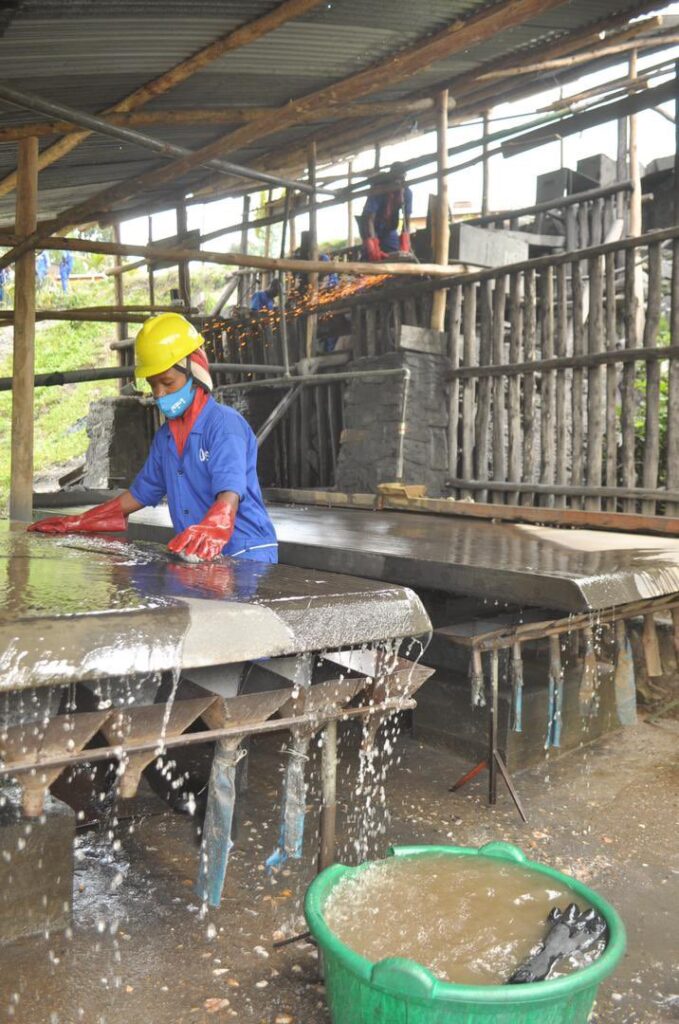
Separation of heavy minerals when deposits are alluvial or orebody usually needs some sort of washing or screening. In both cases, gangue minerals (like quartz) must be separated from valuable metallic minerals, cassiterite. Gravity separation methods use differences in density
between mineral particles to help separate valuable minerals from gangue.
By gravity separation which uses the different densities of minerals to separate heavy minerals from light ones. At many sites, the ore is pre-concentrated before other separation methods are used, the pre-concentration of the ore is done every day using pans, ground sluices. Mostly after recovering the orebody inside the mine, transported outside of the drift or shaft.
due to without screening of the sands on the mine sites before panning and ground sluices, large particles of light minerals can behave like small particles of a heavy mineral, that’s why for effective gravity separation, the tailings collected from the sites and transported into the treatment plant by truck and screened by trommer to be sized to under 2 mm particles to be about the same size so that can be fed to the shaking tables then valuable mineral particles should be liberated from the gangue.
Sometimes tin minerals of Rwinkwavu deposits from tailings are associated with other minerals such as Titanium, Niobium, Iron and Tungsten, magnetic separator used to concentrate the tin.